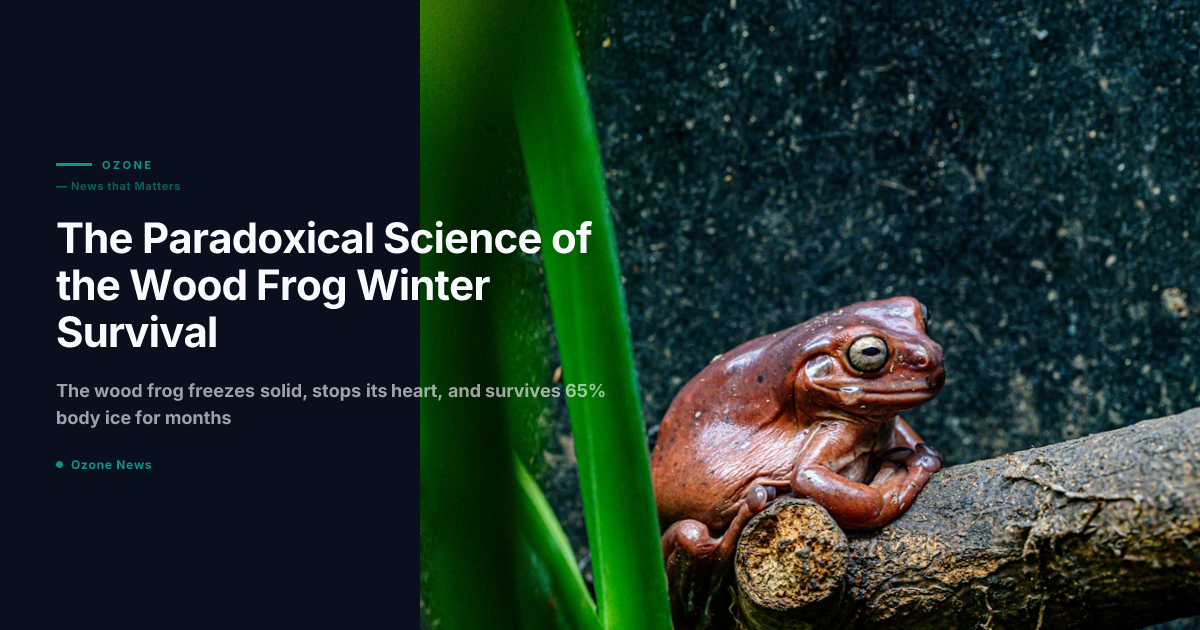
ITHACA, N.Y. — The claim that the North American wood frog (Rana sylvatica) freezes solid, stops breathing, halts its heart, and survives up to 65% of its body water turning to ice is scientifically factual. While it violates basic assumptions about vertebrate biology, the wood frog does not engage in micro-breathing or retain a slow, hidden heartbeat during deep freeze. Instead, it enters a state of true metabolic standstill, a natural form of clinical death that lasts throughout the winter.
HoneyNewspaper's animals and wildlife beat has been tracking the emerging field of cryobiology, where the wood frog's extreme adaptations are inspiring new approaches to mammalian tissue preservation.
The Freezing Sequence | From Rapid Heartbeat to Absolute Zero
The transition into suspended animation is an orchestrated, multi-stage physiological event rather than an instant freeze. When ice crystals touch the frog's permeable skin in late autumn, specialized ice-nucleating proteins trigger an immediate physiological panic response.
During the initial surge, which lasts roughly 0 to 20 hours, the liver rapidly breaks down its glycogen stores and floods the bloodstream with massive amounts of glucose, raising tissue concentrations by up to 100-fold. During this initial phase, the heart does not slow down, it speeds up. The heart pumps at nearly double its normal rate for 10 to 20 hours to distribute this glucose antifreeze to every tissue and organ before the vascular system freezes solid.
Once glucose distribution is complete and ice expands through the abdominal cavity and extracellular spaces, the total shutdown begins. The heart stops completely. As the blood plasma turns to ice, cardiac function drops to absolute zero. Electrocardiogram readings confirm zero electrical or mechanical activity in the heart muscle for months. Breathing ceases entirely. Lungs collapse as fluid is drawn out into body cavities. Gas exchange across the skin stops completely because the cutaneous surface is coated in a solid layer of ice. The brain flatlines. Electroencephalogram monitoring reveals a complete absence of brainwave activity.
According to research published in the American Journal of Physiology, the freezing-induced changes in heart rate follow a precise and repeatable pattern, confirming that the shutdown is not chaotic but tightly regulated at the molecular level.
Why Humans Die from Freezing Versus How the Wood Frog Survives
When human tissue freezes, two lethal events occur: ice crystals puncture cell membranes like tiny daggers, and freezing liquid outside the cells draws out intracellular water, causing the cells to collapse and implode. The wood frog avoids this through a dual-zone protection system.
In the extracellular space, solid ice sheets form containing roughly 65% of total body water. This ice protects internal organs from mechanical compression. In the intracellular space, a dense, unfrozen liquid syrup of concentrated glucose and accumulated urea prevents cellular collapse and halts ice crystal formation. By concentrating high levels of glucose and urea inside the cell, the cytoplasm's freezing point is drastically lowered. Water is allowed to freeze around the cells, while the insides shrink safely into a concentrated, syrupy gel.
The National Park Service has documented how this dual-zone system allows the wood frog to survive temperatures as low as 16 degrees Fahrenheit, or roughly minus 9 degrees Celsius, for weeks at a time.
Resuscitation | The Thaw
In spring, the thawing process occurs from the inside out. As core body temperature rises slightly above freezing, the heart spontaneously resumes beating, even before the brain wakes up or the lungs resume ventilation. In humans, restoring blood flow after extended ischemia releases destructive free radicals in a process known as reperfusion injury. Wood frogs deploy high concentrations of natural antioxidants to neutralize this damage as blood begins recirculating.
Within 10 to 24 hours of thawing, the frog resumes breathing, regains motor control, and hops away toward breeding ponds as though the months of clinical death never happened. The environment desk has reported on how climate change is threatening this delicate cycle, as warming winters and erratic freeze-thaw patterns can trigger premature thaws that leave the frogs vulnerable to predation before they reach breeding grounds.
The implications for human medicine are significant. Researchers at Massachusetts General Hospital have published findings in Nature Communications demonstrating that amphibian-inspired subzero protocols can preserve mammalian tissue for extended periods, raising the possibility that the wood frog's molecular toolkit could one day inform organ preservation, trauma care, and even suspended animation for deep-space travel.
The wood frog does not merely tolerate winter. It has evolved a molecular solution to one of biology's most fundamental problems: how to stop living without dying. Follow ongoing coverage of cryobiology, extreme adaptation, and wildlife science on our animals and wildlife beat.