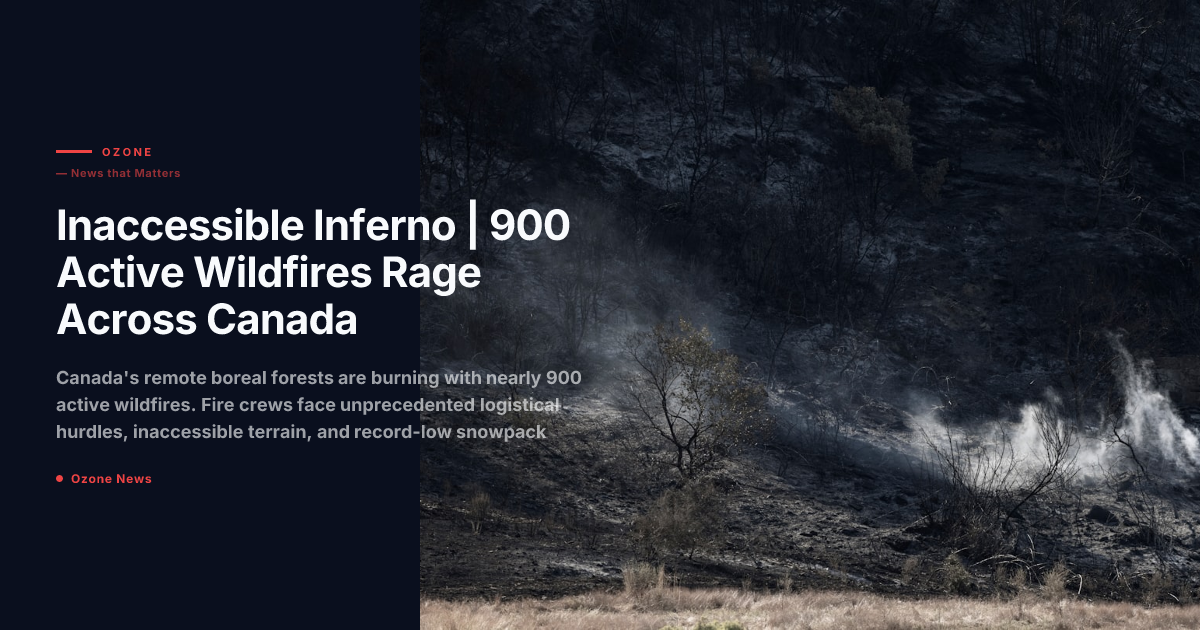
TORONTO — When a wildfire breaks out in a populated region like California or southern Europe, an army of bulldozers, municipal engines, and local volunteer crews can typically establish a physical containment line within hours. But when a fire ignites in northern Canada, the rules of conventional firefighting completely disintegrate.
Moving deeper into July 2026, Canada's national fire dashboard has spiked to a staggering 895 active wildfires stretching from British Columbia to the Atlantic provinces. Of those active blazes, more than 125 are burning entirely out of control, actively threatening remote infrastructure and blanketing major metropolitan hubs like Toronto with a toxic, orange-hued layer of particulate smoke.
The primary hurdle is not a lack of political will or funding. It is the sheer, inhospitable physics of the land itself. Our environment desk has been tracking the 2026 Canadian fire season since the first early-season ignitions in April.
The Fire Ledger | Canada's 2026 Landscape at a Glance
The massive scale of the current fire season is driven by multi-year climate extremes that have left northern soils uniquely primed for explosive ignition. The operational profile as of mid-July 2026 paints a stark picture: 895 total active blazes across the country, with 126 fires actively expanding and entirely uncontained. The total scorched footprint has reached approximately 2.8 million hectares, or roughly 6.9 million acres, impacted year to date. Lightning strikes in remote, high-risk unmanaged forest zones remain the core igniter, and the personnel bottleneck is severe, with only 3,000 to 5,000 specialized wildland firefighters available nationwide to confront a crisis spanning an entire continent.
The community desk has documented how these numbers translate into real human displacement, particularly among Indigenous communities in northern Ontario and Manitoba that have faced repeated evacuation orders throughout June and July.
The Isolation Variable | No Roads, No Runways, No Lines
The definitive reason Canadian wildfires are so difficult to contain comes down to basic geography. Canada holds roughly 24% of the world's boreal forest ecosystem, a massive, continuous belt of spruce, pine, and fir trees that sits on top of a heavily glaciated, boggy landscape. The vast majority of the 900 fires are burning in areas that are completely uninhabited and entirely cut off from the continental road network. There are no highways to roll heavy fire engines down and no staging areas to park support assets.
When an out-of-control blaze threatens a remote community, such as the fast-moving Thunder Bay 36 fire that completely destroyed the remote Namaygoosisagagun First Nation, emergency crews have to fly in using light bush planes on unstable dirt runways under dense, zero-visibility smoke conditions. If a fire is not within a short flight of a lake large enough for a water-scooping aircraft to skim, ground containment becomes a physical impossibility.
According to data from the Canadian Wildland Fire Information System, the remote ignition rate in 2026 has exceeded the ten-year average by 40%, driven almost entirely by dry lightning storms passing over parched, unmanaged terrain.
The Multi-Year Snow Drought and Tinderbox Soil
Compounding the harsh terrain is a severe environmental deficit. A record-low winter snowpack across the northern bands of Canada triggered an exceptionally premature spring melt that left the landscape vulnerable weeks ahead of schedule. Normally, melting snow acts as a natural slow-release irrigation system, keeping the deep mossy floor of the forest saturated well into early summer. Without that moisture cushion, the forest floor dried out a full month ahead of schedule, turning centuries-old organic matter into high-potency kindling.
These conditions allow blazes to morph into zombie fires, deep-seated fires that smolder slowly beneath the snowpack throughout the freezing winter months, eating through subterranean peat moss only to burst back through the surface as active open flames the moment the spring sun hits the canopy. Researchers tracking overwintering fire persistence have documented a sharp increase in holdover ignition events across the Northwest Territories and northern Quebec since 2022, and 2026 is shaping up to be the most active year yet for this phenomenon.
The implications for public health are significant. Smoke from these persistent boreal fires has degraded air quality across the Great Lakes region and the northeastern United States for weeks at a stretch, with particulate matter concentrations spiking well above the thresholds that trigger emergency room visits for respiratory distress.
The Professional Labor Shortage
The final bottleneck is human resource allocation. While Canada boasts a strong roster of roughly 126,000 firefighters, approximately 90,000 of them are localized volunteers trained strictly for house fires, vehicle extractions, and urban boundaries. Only a tiny fraction, estimated at roughly 3,000 to 5,000 professionals, are certified elite wildland specialists equipped to handle massive, multi-directional forest fronts.
Because Canada is the only Group of Seven nation without a unified federal agency dedicated strictly to wildland fire deployment, logistics are heavily fragmented across individual provincial and territorial borders. The Canadian Senate has formally published an urgent proposal to fund a national coordinating office and establish a dedicated federal fleet of modern firefighting aircraft, but regional crews remain pushed to their absolute limits as the peak of fire season approaches. Until a prolonged, multi-week weather shift brings sustained rain across the northern frontier, hundreds of these remote boreal blazes will continue to do exactly what they have done for a century: burn until they run out of fuel.
Follow ongoing coverage of the Canadian wildfire season, boreal forest ecology, and wildland fire policy on our environment desk.