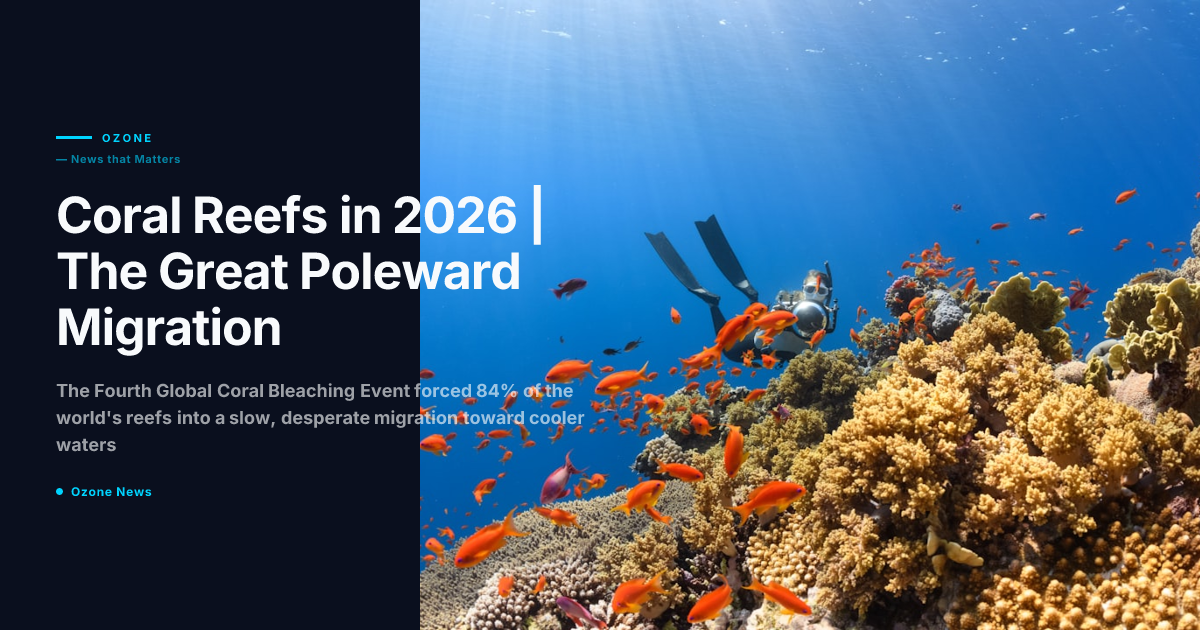
The marine ecosystems of our planet are going through a profound, historically unprecedented geographic reshuffling.
The National Oceanic and Atmospheric Administration (NOAA) and the International Coral Reef Initiative have officially confirmed the conclusion of the Fourth Global Coral Bleaching Event. Spanning from early 2023 through late 2025, this multi-year marine heatwave registered as the single most widespread and destructive thermal stress event ever recorded. An astounding 84.4% of the world's tropical coral reef areas across 83 countries were battered by severe heat, leaving iconic structures like the Great Barrier Reef and the Florida Reef Tract fighting for survival.
But as the crisis subsides, field biologists are documenting a quiet, fascinating biological response. To survive an equator that is rapidly growing too hot, coral populations are moving away from the tropics, slowly expanding their footprints into cooler subtropical waters. Our environment desk has been tracking coral bleaching data and reef migration patterns throughout this event.
What Coral Reefs Do for the World
To understand the gravity of this shift, we must look past the raw aesthetics of these vibrant underwater structures. While coral reefs cover less than 0.1% of the total ocean floor, they function as the literal foundation for global marine ecology and coastal economies.
Reefs act as natural biological breakwaters. Their complex, stony skeletons absorb the brute force of open-ocean swells, protecting trillions of dollars worth of coastal real estate from catastrophic erosion and storm surges, absorbing up to 97% of wave energy in the process. They shelter over 25% of all known marine life, totaling more than one million species, and drive over $36 billion annually in global reef tourism and commercial fishing revenue.
They also serve as primary nurseries for the global seafood industry. Without healthy reef structures to shield juvenile fish, the food chains that sustain over one billion people with direct protein would face permanent, cascading collapse. The food supply implications of accelerated reef loss are among the most underreported dimensions of the climate conversation.
The Great Migration | How Coral Populations Move Poleward
How does a stationary, rock-like animal pack up and move? Individual adult corals are sessile, meaning they are permanently anchored to the seafloor. However, a coral population can migrate across generations through larval drift.
When parent corals spawn, they release millions of free-swimming larvae into the water column. As traditional tropical zones breach the 29 degrees Celsius thermal threshold where corals are forced to expel their life-sustaining symbiotic algae and bleach, the larvae floating in those zones perish. However, major oceanic boundary currents, such as the Kuroshio Current off the coast of Japan and the East Australian Current, are actively acting as aquatic highways, carrying resilient larvae away from the scorching equator and depositing them into cooler, high-latitude environments.
Field researchers have documented new colonization milestones across three key regions:
- Southern Japan: Tropical Acropora and Cyphastrea corals are actively establishing new colonies in temperate bays well outside their historical range.
- Southeast Australia: The furthest recorded southern expansion of stony corals is pushing deep into New South Wales coastal waters.
- Subtropical Atlantic: Slow northward expansion vectors are moving past traditional Florida boundaries toward the Carolinas, tracked closely by NOAA Coral Reef Watch.
The Reality Check | The Latitudinal Squeeze
While coral migration offers a glimmer of climate hope, marine ecologists warn that this movement is not a simple fix. Corals moving to the subtropics are entering a harsh ecological bottleneck, often described as a latitudinal squeeze.
As corals try to move toward the poles to escape the heat, they run into a different chemical wall: ocean acidification. Cooler waters naturally absorb carbon dioxide significantly faster than warm tropical waters. This chemical shift lowers the ocean's pH, stripping the water of the vital aragonite minerals corals require to build their calcium-carbonate skeletons.
Consequently, while a coral species might successfully survive the winter in a new, cooler latitude, its actual physical growth rate slows sharply. The resulting colonies are often fragile, scattered patches rather than the massive, towering structural reef networks that support millions of highly interdependent fish species. The ecological services provided by thin, recently arrived coral patches are a fraction of those generated by mature reef systems that took centuries to construct.
Research published by Carbon Brief mapping 2026 resilient reef systems projects that even optimistic migration scenarios will leave large gaps in reef coverage across the Indo-Pacific by 2050, with no natural substitute for the structural complexity of lost mature reef systems.
Protecting the Pockets of Hope
The conclusion of the Fourth Global Coral Bleaching Event serves as a stark reminder that our oceans are changing faster than at any point in human history. The fact that corals are actively trying to adapt, using global currents to plant the seeds of future reefs in new territories, is a testament to the resilience of the natural world.
But migration alone cannot outrun a rapidly warming planet. True marine conservation requires protecting the mother reefs, the resilient, highly diverse pockets of deep-water coral that have managed to naturally withstand the recent heatwaves in areas like Indonesia, Cuba, and the Bahamas. By fiercely shielding these natural seed banks from local overfishing and pollution, we give these organisms the clean water and the time they need to establish themselves in their new latitudinal homes.
Follow ongoing coverage of reef systems, marine heatwaves, and ocean acidification on our environment desk and our broader animals and wildlife beat.
Sources
- NOAA Coral Reef Watch: Joint Global Press Release on the Conclusion of the Fourth Global Bleaching Event
- OceanCare International: Cumulative Impacts of Marine Heatwaves on Global Reef Systems
- Carbon Brief: Mapping the 2026 Resilient Reef Systems and Global Projections for 2050
- Wikipedia: Global Poleward Migration of Coral Species