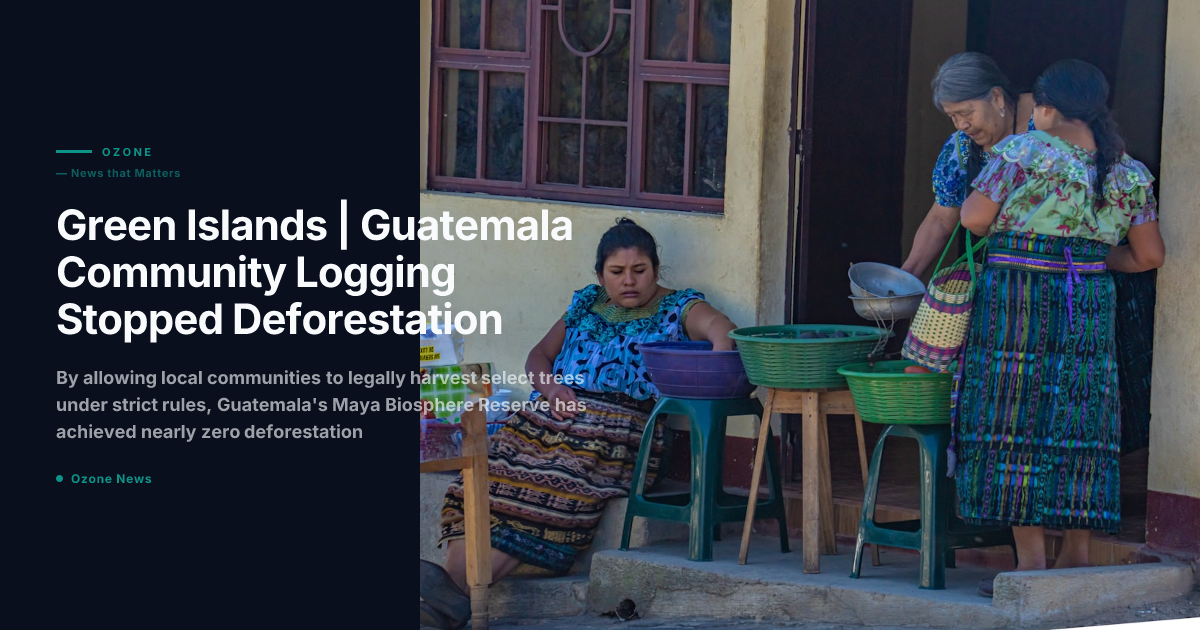
PETEN, Guatemala — For decades, conventional environmental dogma has preached a simple, absolute rule: if you want to save a rainforest, you ban logging entirely. But deep inside the humid lowlands of Guatemala's northern Peten province, a radical experiment is proving that local stewardship and controlled commercial logging can actually achieve the exact opposite result.
While surrounding state-protected parks and buffer zones across Central America's largest rainforest have suffered heavy land encroachment, illegal cattle ranching, and devastating fires, a network of local community concessions has maintained nearly zero deforestation. By turning timber from an illicit threat into a tightly regulated economic asset, Guatemala has created a global blueprint for how human communities and pristine ecosystems can survive side by side.
HoneyNewspaper's environment desk has been tracking community-led conservation models across Latin America as alternatives to top-down protected-area enforcement.
The Conservation Grid | Maya Biosphere Reserve Metrics
Established by the Guatemalan government in 1990 to protect the heart of the Selva Maya, the reserve is deliberately partitioned into specialized management zones. The total reserve footprint spans approximately 2.1 million hectares across Peten Province. Of that, roughly 38% is designated as a multiple-use zone for regulated community management. Twelve active community-managed forestry cooperatives cover approximately 400,000 hectares, operating under a harvesting ratio of typically just 2 mature trees extracted per 1,000 hectares annually.
The long-term performance data is striking. Concessions maintain near-zero deforestation compared to a 13% loss in unmanaged park zones over 24 years. The community impact desk at this publication has documented how this model outperforms traditional fortress conservation across multiple ecological and economic metrics.
How Low-Impact Harvesting Works in Practice
At first glance, a logging site operated by local cooperatives like the Carmelita community looks like any standard commercial timber operation, complete with heavy machinery dragging massive mahogany and Spanish cedar logs toward local sawmills. Behind the scenes, however, the process is governed by military-grade precision. Every single tree slated for removal must be individually identified, mapped, and audited months before a blade touches the bark.
Under strict guidelines certified by the Forest Stewardship Council (FSC), foresters evaluate younger trees to determine how many mature elders can safely be extracted without destabilizing the canopy. By removing only a tiny fraction of mature timber, workers allow sunlight to pierce the thick jungle roof, stimulating natural seed germination and encouraging new growth. Independent auditors inspect every single stump post-harvest to ensure the trees fell in pre-planned directions without crushing surrounding biodiversity.
The system is a far cry from the clear-cutting that characterizes illegal logging operations across the Amazon and Southeast Asia. The science behind selective harvesting is well-established, but Guatemala is one of the few places where it has been implemented at scale with consistent enforcement.
Turning the Forest Into a Local Economic Asset
The real secret to the system's success is financial alignment. In many developing nations, impoverished rural residents are forced to clear-cut rainforests for subsistence farming or cattle grazing simply to survive. In the Maya Biosphere's community concessions, the forest is the local economy. Rather than selling raw, unworked timber to foreign brokers, cooperatives operate local furniture workshops, produce high-end guitar components, and invest in ecotourism cabins.
Households within these community-managed zones report average incomes up to three times higher than Guatemala's national poverty level. Because the local population depends directly on a healthy, standing canopy for their long-term livelihood, they act as frontline rangers, patrolling boundaries with drones and GPS units to aggressively lock out illegal land-grabbers and forest fires.
By proving that sustainable harvesting protects biodiversity better than blank prohibitions, Guatemala's community model stands as a shining beacon for global conservation. The model is being studied by conservation groups in the Amazon Basin, the Congo Basin, and Southeast Asia as a potential template for reconciling human development with forest protection. Follow ongoing coverage of deforestation, community forestry, and conservation innovation on our environment desk and our ethics and accountability beat.