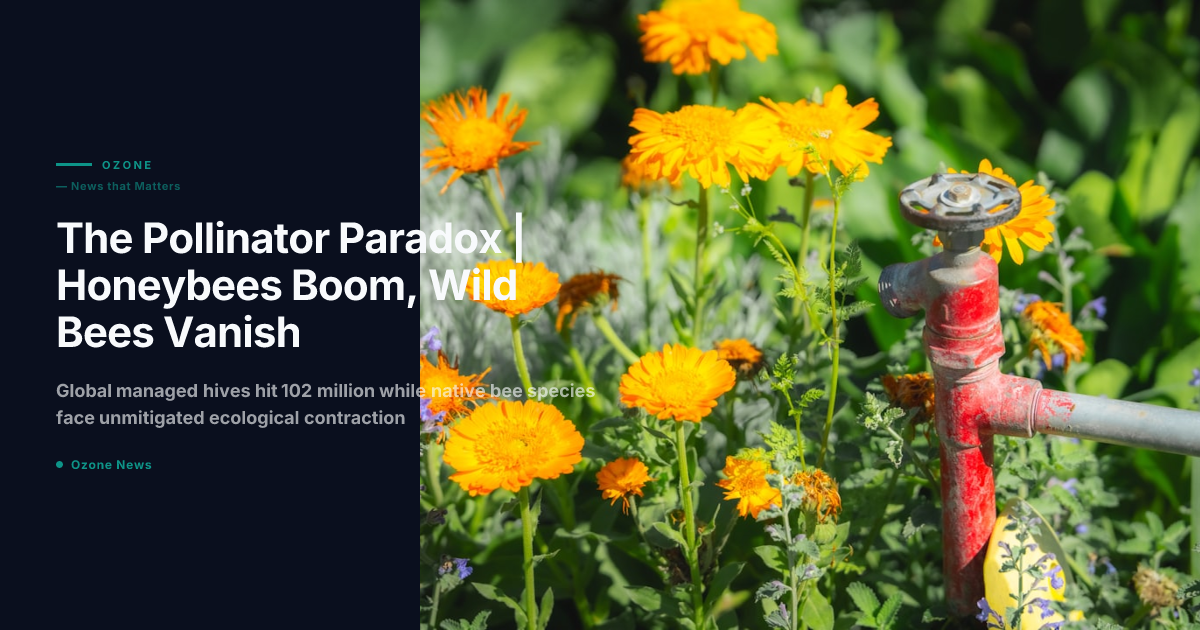
For more than a decade, the public has rallied behind a single environmental battle cry: save the bees. From cereal boxes to documentary features, the narrative has largely framed the insect world as sitting on the edge of a total, irreversible population collapse.
But as field biologists and agricultural economists examine the global data, the reality has evolved into a deeply complicated contradiction. The answer to whether the bee population is expanding or contracting depends entirely on one vital distinction: are we talking about managed commercial livestock, or the wild species living in the undergrowth?
When you separate the two groups, you reveal an ecological paradox. One population is hitting historic, record-high numbers. The other is quietly slipping toward extinction. Our environment desk has been tracking pollinator data across both categories for the past two years.
The Expansion | Honeybees as Global Livestock
If you look strictly at the macro-level numbers, the idea that bees are going extinct is a myth. According to data tracked by the United Nations Food and Agriculture Organization (FAO), the global population of managed honeybees is actively expanding.
There are currently an estimated 102 million managed honeybee colonies operating worldwide, representing a 47% increase in global hive counts since 1990, driven heavily by the rapid agricultural industrialization of Asia, Africa, and South America. The western honeybee is not just an insect. It is a vital, multi-billion-dollar pillar of global commercial agriculture. As international demand for resource-intensive crops like almonds, avocados, and blueberries scales upward, commercial beekeepers scale their inventory to match.
However, this raw population expansion masks a highly volatile operational crisis. While the total number of hives is up, maintaining those baselines has become extraordinarily expensive. Commercial apiaries are battling devastating overwinter colony losses that routinely reach 60% to 70% in the United States and Europe. Hives are continuously hammered by pests, specifically the blood-sucking Varroa destructor mite, pathogens including deadly viral strains, pesticides like neonicotinoids, and poor nutrition caused by single-crop industrial farming.
The only reason the commercial population does not permanently collapse is that human caretakers artificially prop it up every spring, painstakingly splitting surviving hives, breeding new queens, and feeding colonies sugar water to force recovery. The food and agriculture implications of this fragile dependency are significant and underreported.
The Contraction | The Silent Disappearance of Wild Bees
While honeybees have an international industry dedicated to keeping them alive, the planet's wild, native bees are fighting an unmitigated, catastrophic contraction.
There are more than 20,000 distinct species of wild bees globally, including bumblebees, sweat bees, mason bees, and miner bees. Unlike honeybees, these insects do not live in managed boxes, do not produce commercial honey, and have no corporate infrastructure to rebuild their numbers when a season goes wrong. Because they bear the full weight of environmental degradation without any human safety net, wild populations are collapsing at an alarming rate.
- Meadow Eradication: The expansion of manicured suburban lawns and industrial monoculture farming has wiped out roughly 97% of natural wildflower meadows across Western nations over the past century, effectively starving native species out of their historical nesting footprints.
- Geographical Compression: Climate tracking reveals that extreme summer heatwaves have compressed the active geographical territory of North American and European bumblebees by up to 300 kilometers, trapping species in shrinking ecological pockets.
- The Extinction Horizon: The European Red List of Bees classifies wild honeybees as extinct or critically endangered across the vast majority of their native European ranges. The iconic American rusty patched bumblebee has declined by a staggering 90% over the last two decades.
The animals and wildlife beat at this publication has documented how the rusty patched bumblebee's range has contracted from widespread presence across 28 U.S. states to isolated fragments in fewer than a dozen.
Why Commercial Honeybees Can Hinder Wild Recovery
The final twist in the pollinator paradox is that the expansion of commercial honeybees can actively accelerate the contraction of wild species.
When a commercial operation deploys millions of non-native honeybees into a natural ecosystem to pollinate a crop, it creates intense, unnatural competition for local resources. A single honeybee hive can gather enough pollen in one season to feed the offspring of hundreds of wild, native bees. Packing thousands of stressed commercial bees into a shared geographic space also creates a disease reservoir, allowing viruses to jump readily from commercial hives onto wild bumblebees visiting the same flowers.
According to researchers at The Xerces Society for Invertebrate Conservation, the overlap between managed honeybee expansion zones and native bee habitat loss zones is not coincidental. It is a measurable, documented competitive displacement pattern.
True environmental balance cannot be solved by simply buying a backyard honeybee hive. If we want to halt the contraction of the wild pollinators that keep natural ecosystems structurally alive, the solution requires focusing on the terrain itself: planting native wildflowers, leaving natural soil undisturbed for ground-nesting species, and reducing reliance on industrial chemical treatments. The honeybee will survive because humanity requires its labor. The real test of our ecological stewardship is whether we leave enough room for the rest. Follow ongoing pollinator coverage on our environment desk.