KINGSTON, Jamaica — For over a decade, the geopolitical race to mine the deep ocean floor was framed as a straight tradeoff: balancing the risk of localized benthic habitat destruction against the urgent global need for battery metals like nickel, cobalt, copper, and manganese.
However, that trade-off narrative has been upended. Following the annual assembly of the International Seabed Authority (ISA) in Kingston, Jamaica, member states ended their high-stakes negotiations without adopting a finalized Mining Code or setting a firm deadline for commercial exploitation guidelines.
At the absolute center of this diplomatic gridlock is a scientific revelation that fundamentally challenges oceanography: the discovery of dark oxygen — aerobic oxygen produced in the pitch-black depths of the abyssal plain, generated directly by the very polymetallic nodules mining corporations intend to scoop off the seafloor. HoneyNewspaper's environment desk has been tracking the ISA proceedings since the dark oxygen discovery broke into the mainstream policy conversation.
The Regulatory Gridlock | ISA 2026 Status Report
The geopolitical coalition calling for a precautionary pause or explicit moratorium on deep-seabed mining has expanded to 46 nations, representing over a quarter of ISA member states. What began as a fringe environmental position has hardened into a mainstream diplomatic bloc that now includes the United Kingdom, Germany, Greece, Kenya, and the Republic of the Congo.
The core arena for this regulatory battle is the Clarion-Clipperton Zone (CCZ), a 4,500-mile Pacific abyssal plain sitting at approximately 13,000 feet below the surface. The CCZ contains an estimated 21 billion tonnes of polymetallic nodules, mineral concretions rich in nickel, cobalt, copper, and manganese that have accumulated over millions of years on the seafloor. These nodules represent one of the largest untapped mineral reserves on the planet, and the commercial engine behind the push to mine them is The Metals Company (TMC), operating through its subsidiary Nauru Ocean Resources Inc. (NORI).
The accountability desk has reported on how the regulatory vacuum at the ISA creates a permissive environment for corporate actors to test the boundaries of international seabed law before the rules are even written.
Decoding Dark Oxygen | Seawater Electrolysis at 4,000 Meters
Prior to recent field research in the Clarion-Clipperton Zone, scientific consensus held that all free oxygen on Earth was produced exclusively via oxygenic photosynthesis by plants, algae, and cyanobacteria in sunlit surface waters. Deep-ocean oxygen was assumed to arrive solely via the global ocean conveyor belt, slowly sinking from northern surface currents into the abyss over centuries.
However, an international research team sampling the CCZ abyssal floor recorded an anomaly: oxygen levels inside sealed benthic chambers placed over polymetallic nodule fields were not dropping due to respiration, they were continuously rising. The chambers, designed to measure oxygen consumption by deep-sea organisms, were instead capturing oxygen production in an environment where photosynthesis is physically impossible.
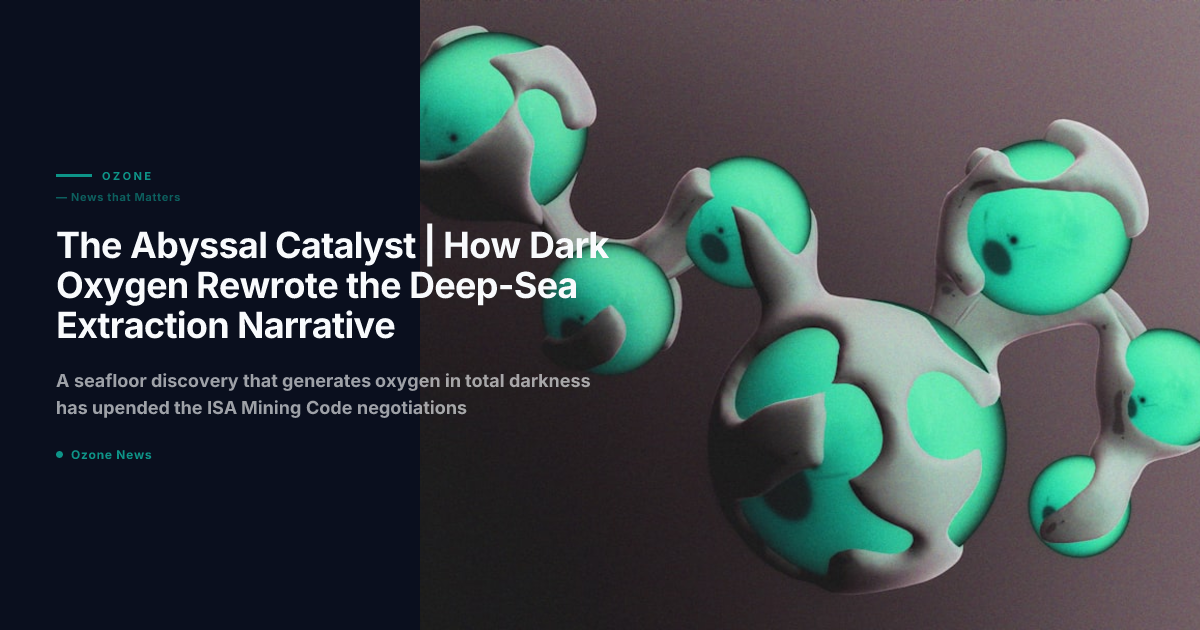
Subsequent laboratory testing revealed that polymetallic nodules — potato-sized deposits rich in transition metals including manganese, iron, nickel, and cobalt — can act as natural geo-batteries. When multiple nodules rest together in conductive seawater, the chemical potential difference across their surfaces can approach 0.95 to 1.0 volts. Clustered together, this charge is sufficient to trigger seawater electrolysis, splitting H2O molecules directly into hydrogen and oxygen gas in total darkness, without sunlight, without biology.
The implications of this finding extend far beyond a single research paper. If the abyssal plain is not a passive sink for oxygen produced elsewhere but an active generator in its own right, then the ecological baseline for deep-sea ecosystems must be completely reconsidered. The science desk's recent coverage of ocean deoxygenation highlights why any additional stress on marine oxygen dynamics is a planetary-scale risk.
The Environmental Risk | Stripping the Abyssal Life-Support Engine
The discovery of dark oxygen has transformed the environmental debate from a question of regional habitat disruption to one of potential ecosystem-wide collapse.
If heavy crawling harvesters strip millions of tons of polymetallic nodules from the abyssal silt, they remove the very catalyst generating oxygen for abyssal organisms that rely on localized oxygenation. The nodules are not inert rocks; they are active electrochemical surfaces that may sustain benthic life in ways that oceanographic models never anticipated.
Beyond the direct removal of nodule batteries, commercial nodule collection relies on hydraulic vacuum systems that stir up massive, ultra-fine sediment plumes. These suspended particles drift for hundreds of miles, potentially smothering benthic organisms, blocking delicate feeding structures, and disrupting chemical reactions across adjacent nodule fields that lie far outside the mining lease boundary.
Marine biologists have raised a particularly sharp concern: the CCZ hosts species that exist nowhere else on Earth, many of which have never been formally described by science. The marine wildlife beat has documented how deep-sea ecosystems operate on timescales measured in centuries, not decades, meaning that any recovery from mining disturbance would unfold across timespans longer than human civilization itself.
The Geopolitical Collision | Critical Minerals Versus Precautionary Pauses
The scientific uncertainty around dark oxygen has severely complicated commercial timelines. TMC and other corporate entities have pressed the ISA to approve commercial exploitation permits, citing high demand for critical minerals required for electric vehicle batteries and renewable energy storage infrastructure.
However, during the ISA Assembly, member states led by a growing African coalition — including Kenya, Madagascar, Malawi, and the Republic of the Congo — joined European powers in taking a firm stance: no commercial extraction permits will be issued until independent, peer-reviewed baseline science can map the full scope of dark oxygen and its role in ocean stability.
This is not a symbolic position. With the ISA Legal and Technical Commission actively investigating contractor compliance and the Mining Code remaining unfinished, the deep ocean floor remains legally off-limits to commercial mining. It represents a landmark moment where a genuine scientific discovery, not activism or lobbying, directly halted an industrial gold rush before it began.
The coming months will determine whether the moratorium coalition holds or fractures under pressure from nations that view seabed minerals as essential to their energy transition strategies. What is already clear is that the dark oxygen discovery has permanently altered the terms of the debate. The abyssal plain is no longer a barren wasteland waiting to be harvested; it is an active, living electrochemical system that science is only beginning to understand. Follow ongoing coverage of deep-sea policy, ocean chemistry, and the ISA negotiations on our environment desk.