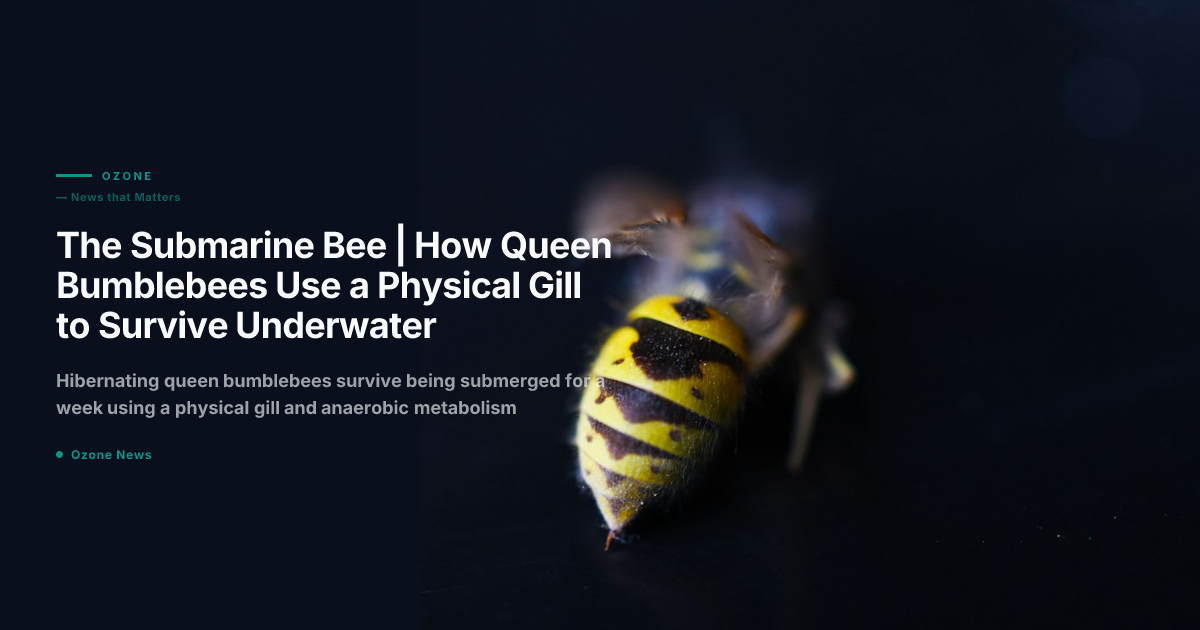
OTTAWA, Ontario — Nature is full of extraordinary survival mechanisms, but breathing underwater while buried in freezing mud was never considered a skill possessed by the common bumblebee.
Yet, a fascinating study published in the Proceedings of the Royal Society B reveals that hibernating queen bumblebees (Bombus impatiens) can survive being completely submerged in water for up to an entire week. The discovery, which originated from a serendipitous lab refrigerator malfunction, completely upends what entomologists thought they knew about terrestrial insect resilience. HoneyNewspaper's science desk has been tracking pollinator adaptation research as climate change reshapes the environments that bees have evolved to survive.
To survive winter flooding, these queens do not simply hold their breath. They utilize a multi-layered physiological strategy that transforms them into temporary aquatic organisms. A documentary breakdown of the research visualizes how the physical gill mechanism operates at the microscopic level.
The Physical Gill and Extreme Hibernation
When temperatures drop in the fall, a newly mated queen bumblebee burrows into the soil to enter a state of deep hibernation known as diapause. In this state, her heart rate plummets and her metabolism drops by up to 99%, meaning she requires a microscopic fraction of her normal caloric and oxygen intake.
However, shallow underground burrows are highly susceptible to spring flooding. When submerged, the queen deploys three distinct survival mechanisms to avoid drowning. First, because a bumblebee is covered in dense, fuzzy hairs called setae, a thin layer of air naturally clings to her body when submerged. This trapped bubble acts as a continuous air chamber or physical gill. As the bee consumes the oxygen inside the bubble, more oxygen naturally diffuses into it from the surrounding water, while exhaled carbon dioxide diffuses out through her spiracles. Second, once underwater, the queen forces her already slowed metabolism to drop even further, down to just one-sixth of its standard diapause rate, drastically cutting her need for oxygen. Third, if the physical gill cannot supply enough oxygen, the queen's body automatically switches to anaerobic metabolism, producing energy without oxygen. While this keeps her alive, it creates a toxic buildup of lactic acid in her system that she must breathe off heavily once she finally emerges from the water.
The study, led by ecologist Sabrina Rondeau and physiologist Charles-Antoine Darveau, documented survival up to 8 days underwater in the common eastern bumblebee (Bombus impatiens). The findings were published in Proceedings of the Royal Society B.
The pollinator paradox at this publication has documented how wild bee species face existential threats that managed honeybees do not, making evolutionary adaptations like this one critical for species survival.
Why This Matters in a Changing Climate
The researchers note that this evolutionary adaptation is a vital buffer against climate change. As global temperatures warm, erratic weather patterns are producing heavier, more unpredictable winter rainfalls and rapid snowmelts, frequently flooding the subterranean habitats where these queens sleep. Because the queen is the sole survivor of her colony charged with starting a new generation in the spring, her death during hibernation would eradicate an entire genetic lineage.
While the queens demonstrated a remarkable ability to clear lactic acid and fully recover after a week underwater, researchers warn there is likely a point of no return if flooding becomes too frequent or lasts for consecutive weeks. The honeybee colony collapse coverage at this publication has examined how extreme weather events are compounding the pressures on pollinator populations already stressed by pesticides, habitat loss, and disease.
The discovery that a terrestrial insect can function as a temporary aquatic organism opens new questions about what other survival mechanisms remain undiscovered in the soil beneath our feet. As climate change accelerates the frequency of extreme flooding events, the bumblebee's physical gill may prove to be one of the most important evolutionary adaptations for pollinator survival in the coming decades. Follow ongoing coverage of pollinator science, climate adaptation, and entomology on our science desk.